ADHD and the Developing Brain: Why Your Child Thinks, Feels and Acts Differently
If your child has ADHD, you might sometimes wonder how they can concentrate on a favourite game for an hour but struggle to stay focused on homework for five minutes. You might see them understand a rule perfectly and then break it moments later, become overwhelmed by a seemingly small disappointment, or forget an instruction almost as soon as you have given it.
These behaviours can be frustrating and confusing, particularly when it seems as though your child is capable of doing something but cannot do it consistently.
ADHD reflects genuine differences in how a child’s developing brain regulates attention, motivation, impulses, working memory and emotions. It is not simply a behaviour problem, a result of poor parenting or evidence that a child is not trying hard enough.
Understanding what is happening inside the ADHD brain can change the way parents interpret what they see on the outside. Instead of asking, “Why won’t my child do this?”, it can be more useful to ask, “What is making this difficult for my child’s brain right now?”
Is ADHD really different in the brain?
Yes. ADHD is a neurodevelopmental condition, which means it is connected with differences in how the brain develops and functions.
Researchers have identified differences across several brain networks involved in attention, self-control, motivation, working memory and emotional regulation. These differences are seen across groups of people with ADHD, although there is no single brain scan that can diagnose ADHD in an individual child.
One particularly important area is the prefrontal cortex. This part of the brain helps children plan, remember what they are supposed to be doing, resist impulses and think about what might happen next.
You can think of the prefrontal cortex as part of the brain’s management system. It helps organise behaviour rather than simply generating it.
For a child with ADHD, this management system can be less reliable. Your child might know that they are supposed to put their shoes on, remember their lunchbox and leave for school, but knowing the routine is different from consistently holding all those steps in mind and carrying them out.
This is why ADHD can create a frustrating gap between what a child knows and what they are able to do consistently in the moment.
Why can my child focus on games but not homework?
One of the most confusing things about ADHD is that children with the condition can sometimes concentrate extremely well.
This happens because ADHD is not simply an inability to pay attention. It is better understood as difficulty regulating attention according to what the situation requires.
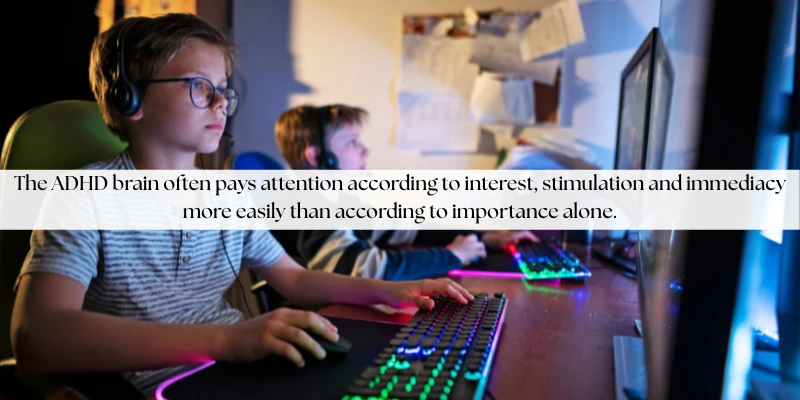
Some activities naturally capture attention because they are interesting, novel, fast-moving or immediately rewarding. Video games are a good example. They often provide constant stimulation, clear goals, immediate feedback and frequent rewards.
Homework can be very different. The reward might be distant, the task repetitive and the child might need to organise themselves before they can even begin.
Brain systems involving dopamine and other neurotransmitters play an important role in motivation, reward and attention. These systems function differently in ADHD, which can make low-stimulation tasks unusually difficult to begin and sustain.
This means your child might spend an hour building something, drawing, researching dinosaurs or playing a game while apparently being unable to complete a short worksheet.
It does not necessarily mean they are choosing when to have ADHD.
The ADHD brain often pays attention according to interest, stimulation and immediacy more easily than according to importance alone.
Why does my child seem to forget everything I say?
Parents of children with ADHD frequently describe giving an instruction, receiving a clear “yes”, and then discovering several minutes later that nothing has happened.
This can involve working memory, which is the brain’s ability to temporarily hold information in mind while using it.
Imagine saying:
“Put your shoes away, take your lunchbox into the kitchen and then get changed.”
Your child has to hold all three instructions in mind while carrying out the first one. If working memory is unreliable, the second and third steps can disappear before the first has been completed.
The child might then notice the dog, see a toy or remember something completely unrelated. From the parent’s perspective, it looks as though they ignored the instruction.
The child might genuinely have intended to follow it.
Working-memory difficulties can make children with ADHD appear forgetful, careless or disobedient even when they understood the instruction perfectly well.
Shorter instructions, visual reminders and one step at a time can reduce the amount of information their brain has to hold at once.
Why does my child act before thinking?
Children are still developing impulse control throughout childhood and adolescence, but this process can be particularly difficult in ADHD.
Impulse control requires the brain to create a tiny pause between an urge and an action.
During that pause, a child needs to think:
- What am I about to do?
- What is the rule?
- What might happen afterwards?
- Should I do something different?
For children with ADHD, that pause can be unreliable.
They might call out an answer before remembering to raise their hand, push into a game without asking, grab something they want or make a comment before considering how another person will feel.
The child can often explain the rule perfectly afterwards.
That distinction is important.
A child with ADHD might know what they should have done but struggle to access that knowledge quickly enough to stop the behaviour in real time.
This is why you might hear:
- “I forgot.”
- “I didn’t mean to.”
- “I don’t know why I did it.”
- “It just happened.”
These responses can sound like excuses, but they may accurately describe the child’s experience of impulsivity.
Why does my child repeat the same mistake even after consequences?
Parents sometimes assume that if a consequence was unpleasant enough, the child should remember it next time.
That requires several cognitive processes to occur quickly.
The child must remember the previous event, connect it with the current situation, resist the immediate impulse and choose a different behaviour before acting.
ADHD can interfere with each part of that sequence.
Consequences that happen much later can also have less influence on an ADHD brain than immediate outcomes. A child might understand that losing gaming time tonight is a consequence of something they are doing now, but the immediate impulse can still feel far more powerful than the delayed consequence.
This does not mean consequences are useless.
It means children with ADHD usually learn more effectively from immediate, predictable feedback and repeated opportunities to practise the desired behaviour than from increasingly severe punishment.
Why are transitions so difficult for children with ADHD?
Moving from one activity to another requires several executive functions at once.
The child has to stop what they are currently doing, shift their attention, remember what comes next and generate enough motivation to begin the new activity.
That can be particularly difficult when the child is leaving something highly interesting for something less rewarding.
This is why transitions such as turning off a game, getting ready for school, beginning homework or preparing for bed can become common points of conflict.
To a parent, it might appear that the child has simply decided not to cooperate.
From the child’s perspective, their brain might be struggling to disengage and reorganise itself for the next demand.
Warnings, visual schedules, timers and predictable routines can help an ADHD brain prepare for transitions before the change occurs.
Why are emotions so intense with ADHD?
Parents are sometimes surprised to discover how closely ADHD can be connected with emotional regulation.
A child might become intensely frustrated when something goes wrong, react strongly to criticism or move from calm to furious remarkably quickly.
These emotions are genuine.
The brain systems involved in controlling attention and impulses also contribute to regulating emotional responses. When regulation is difficult, feelings can arrive quickly and become difficult to contain.
A small disappointment might therefore produce a very large response.
This does not necessarily mean that the child believes the situation is objectively catastrophic. Their emotional system has simply reached a high level of activation before the regulatory system has caught up.
Many children with ADHD experience emotions quickly, intensely and with less time available to regulate them before reacting.
The goal is not to teach the child that their feelings are wrong. It is to gradually help them recognise those feelings earlier and build ways of responding before the emotion takes over.
Why does my child calm down and then act as though nothing happened?
This can be another confusing feature for families.
A child might have an enormous emotional outburst and, twenty minutes later, appear completely ready to move on.
Meanwhile, everyone else in the house is still recovering.
Children with ADHD can experience emotions very intensely in the moment without necessarily remaining emotionally attached to them for the same length of time.
Once their nervous system has settled, the event can feel finished.
This does not mean that the child did not care about what happened.
It does mean that attempting to discuss consequences or teach a lesson during the height of the outburst is often ineffective. The child’s regulatory capacity is already overwhelmed.
Problem-solving is usually more productive after an ADHD child has returned to a regulated state.
Why is my child so sensitive to criticism?
Children with ADHD often receive enormous amounts of corrective feedback:
- Sit down.
- Stop interrupting.
- Pay attention.
- You forgot again.
- Slow down.
- Where is your homework?
- Why didn’t you listen?
Even when adults are simply trying to teach appropriate behaviour, the cumulative effect can be significant.
A child might begin expecting criticism before it occurs. Small corrections can then trigger embarrassment, defensiveness or anger because they connect with a much larger history of feeling unsuccessful.
This can contribute to low self-esteem, anxiety and avoidance.
One of the most important protective factors for a child with ADHD is having adults who recognise their difficulties without allowing those difficulties to define who they are.
Correction is still necessary. But children also need repeated experiences of competence, connection and being noticed when things go well.
Does ADHD affect learning even when my child is intelligent?
Absolutely.
ADHD does not determine intelligence. Children with ADHD can have intellectual abilities anywhere across the usual range, including gifted abilities.
The problem is often not understanding the information.
It is managing everything required to demonstrate that understanding.
A child might understand a maths concept but forget which step they were completing. They might have excellent ideas for a story but struggle to organise them on paper. They might know the answer but miss half the teacher’s instruction.
Executive functioning plays a major role in learning. This includes planning, organisation, working memory, task initiation, time management and self-monitoring.
A child can therefore be highly capable while producing inconsistent schoolwork.
ADHD often affects the management of learning rather than the child’s capacity to understand complex ideas.
Why does my child struggle to start tasks?
Beginning an activity involves more than deciding that it needs to be done.
The brain must organise the first step, generate motivation, estimate effort and resist more immediately interesting alternatives.
For children with ADHD, task initiation can be particularly difficult when an activity feels boring, complicated or overwhelming.
This can create the familiar situation in which homework takes an hour to begin even though the actual task takes fifteen minutes.
Parents might interpret this as procrastination or deliberate resistance.
Sometimes it is more useful to reduce the entry point.
Instead of:
“Do your homework.”
Try:
“Open your maths book to page 24.”
Breaking a task into a visible first action can make it easier for an ADHD brain to move from intention into action.
Why does my child seem to have no sense of time?
Time management depends heavily on executive functioning.
Children with ADHD might underestimate how long something will take, lose track of how much time has passed or struggle to act on a future deadline until it becomes immediate.
Twenty minutes can feel abstract until there are only two minutes left.
This can contribute to rushed mornings, unfinished assignments and arguments about leaving the house.
Externalising time can help.
Clocks, countdowns, timers and visual schedules turn an invisible concept into something the child can see.
Children with ADHD often benefit from having time made concrete because internal time awareness can be unreliable.
Does ADHD affect motivation?
Yes, although this does not mean children with ADHD are inherently unmotivated.
Motivation is strongly connected with reward. Some children with ADHD find delayed rewards less effective at driving behaviour than immediate feedback.
“Work hard all term and you might get a good report” is psychologically distant.
“Finish these three questions and then show me” provides an immediate goal.
This is one reason shorter tasks, frequent feedback and small achievable goals can work so well.
ADHD often affects the brain’s ability to maintain effort when rewards are delayed, uncertain or insufficiently stimulating.
That is very different from saying the child simply does not care.
Why can ADHD make mornings so difficult?
Morning routines place heavy demands on executive functioning.
The child might need to:
- wake up,
- remember the sequence of getting dressed,
- find their belongings,
- monitor the time,
- eat breakfast,
- cope with distractions,
- switch between tasks,
- leave the house by a deadline.
Adults perform many of these behaviours automatically. A child with ADHD might need to consciously reconstruct the routine every morning.
This is why repeated verbal reminders can become exhausting for everyone.
Visual checklists, preparing belongings the night before and keeping important items in consistent locations can reduce the amount of executive functioning required.
Good ADHD routines reduce the number of decisions and memories a child needs to manage independently.
What helps the developing ADHD brain?
Children with ADHD benefit from environments that provide some of the organisation their developing executive functions cannot yet provide consistently for themselves.
Helpful strategies can include:
- predictable routines
- clear and brief instructions
- visual reminders
- immediate feedback
- movement opportunities
- manageable task sizes
- preparation before transitions
- regular sleep
- positive reinforcement
- explicit teaching of organisational skills.
These supports are sometimes misunderstood as making things too easy for the child.
They are better understood as scaffolding.
We do not remove scaffolding from a building before the structure can support itself. In the same way, children gradually take over more responsibility as their skills develop.
Effective ADHD support provides external structure while the child develops greater internal self-regulation.
Does medication change the ADHD brain?
ADHD medications influence neurotransmitter systems involved in attention, motivation and impulse control.
For many children, this can make it easier to concentrate, pause before acting, follow instructions and remain engaged with tasks.
Medication does not teach organisational skills or parenting strategies, and it does not change who the child is.
A useful way to think about it is that medication can sometimes make important brain systems more available for learning.
The child still needs to practise waiting, organising, regulating emotions and completing tasks.
ADHD medication can reduce core symptoms for many children, making it easier for them to use the skills they are being taught.
Medication is not appropriate or necessary for every child, and treatment decisions should be made with an appropriately qualified clinician.
Will my child’s brain eventually catch up?
Brain development continues throughout adolescence and into early adulthood, so children can become much better at planning, self-control and emotional regulation as they mature.
ADHD, however, is not simply a developmental delay that always disappears.
For some people, symptoms become considerably less impairing over time. Others continue experiencing difficulties with attention, organisation, impulsivity or restlessness into adulthood.
The way ADHD looks can also change.
A highly active child might become a teenager who feels internally restless rather than physically hyperactive. Forgotten schoolbooks might eventually become missed appointments or difficulty managing deadlines.
Children do not necessarily grow out of ADHD, but they can grow into increasingly effective ways of understanding and managing it.
Does ADHD mean my child will always struggle?
No.
ADHD creates genuine difficulties, but it does not determine a child’s future.
Children with ADHD can be creative, curious, persistent, energetic, humorous and capable of becoming deeply knowledgeable about subjects that interest them.
Their development is also influenced by the environments around them.
A child who spends years being told that they are lazy, naughty or irresponsible might eventually believe those descriptions.
A child who understands, “Some things are harder for my brain, but I know why and I know what helps,” develops a very different story about themselves.
Understanding ADHD allows children to replace shame with self-knowledge and gradually develop strategies that work with their brain rather than constantly fighting against it.
Why does understanding the ADHD brain matter for parents?
Understanding the brain does not mean removing expectations or excusing harmful behaviour.
Children with ADHD still need to learn how to wait, follow rules, complete responsibilities, repair mistakes and treat other people respectfully.
The difference is how adults help them get there.
If we interpret every forgotten instruction as laziness, every interruption as disrespect and every emotional outburst as deliberate manipulation, the response is likely to focus primarily on punishment.
When we recognise the developmental difficulty underneath the behaviour, we can still maintain the boundary while also teaching the missing skill.
Your child might need the instruction broken down.
They might need the consequence to be more immediate.
They might need a visual reminder rather than another verbal warning.
They might need time to regulate before discussing what happened.
Understanding ADHD changes the question from “How do I make my child behave?” to “What skill does my child need in order to manage this situation more successfully?”
That shift does not lower expectations.
It gives the child a more realistic pathway towards meeting them.
Where can I learn more about ADHD in children?
If you are concerned about your child’s attention, impulsivity, activity levels or emotional regulation, our complete ADHD in Children guide explains the signs of ADHD, how childhood ADHD is assessed, the different ADHD presentations and the treatment and support available to Australian families.
You can also explore our broader Child Mental Health guide for information about anxiety, autism, depression, OCD, learning disorders, tic disorders, trauma and other conditions that can affect children’s behaviour and development.
Reviewed and updated: 7 August 2026