Signs of Anxiety in Young Children That Are Easy to Miss
When adults think about anxiety, we often imagine someone saying that they feel worried, nervous or afraid. Young children rarely describe anxiety so clearly.
Instead, anxiety in young children often appears through behaviour, emotions and physical symptoms. A child might become unusually clingy, angry, reluctant to try something new or repeatedly complain of a sore stomach without ever saying, “I’m anxious.”
This can make childhood anxiety surprisingly easy to miss.
It is also important to remember that some fear and anxiety are completely normal during childhood. Babies and toddlers commonly become distressed when separated from caregivers, while preschool children might fear darkness, unfamiliar people, animals or being alone. Anxiety becomes more concerning when it is unusually intense, persists over time or begins interfering with play, friendships, childcare, school or family life.
Here are some of the less obvious signs of anxiety in young children that parents might notice at home.
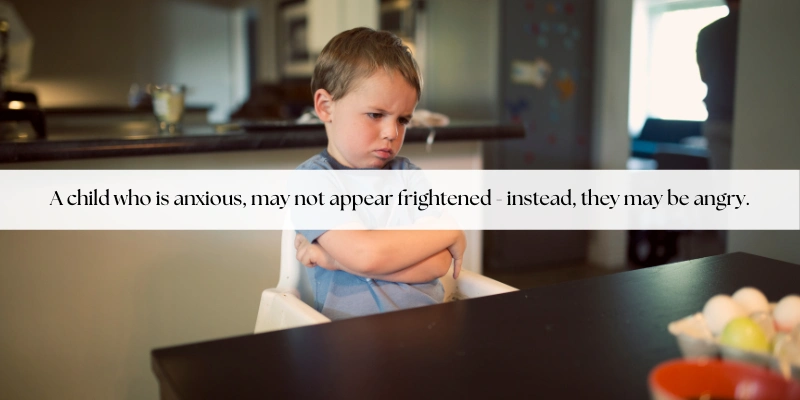
Why can anxiety look like anger in a young child?
One of the easiest signs of childhood anxiety to misunderstand is irritability.
An anxious child does not always look frightened. They might look angry.
You might notice that your child becomes upset over seemingly small problems, has a lower tolerance for frustration or reacts intensely when something unexpected happens.
This makes sense when we consider what anxiety does. When a child believes that something difficult or threatening might happen, their body becomes more alert and prepared to respond. They can become tense, restless and emotionally reactive. Irritability is recognised as one possible feature of childhood anxiety.
A child might therefore explode when it is time to leave home, become angry before childcare or argue intensely about an unfamiliar activity.
The anger is real, but it might not be the whole story.
Sometimes the behaviour that looks like anger is sitting on top of fear, uncertainty or a feeling that the child cannot cope with what is about to happen.
This does not mean that every tantrum is anxiety. Young children have tantrums for many reasons. The useful question is whether strong reactions repeatedly occur around situations that your child finds uncertain, frightening or difficult to manage.
Why can anxiety look like stubbornness or refusal?
Avoidance is one of the most important signs of anxiety.
When something makes us frightened, moving away from it brings immediate relief. Children discover this very quickly.
An anxious child might refuse to:
- go into childcare,
- join a birthday party,
- speak to an unfamiliar adult,
- sleep away from a parent,
- try a new activity,
- enter a particular room,
- participate in something they previously enjoyed.
From the outside, this can look like stubbornness.
The child might simply say:
- “I don’t want to.”
- “No.”
- “I hate it.”
- “You can’t make me.”
Young children often cannot explain the chain underneath the refusal: “I am anticipating something uncomfortable and I don’t feel confident that I can cope with it.”
When avoidance repeatedly appears around situations that create fear or uncertainty, apparent defiance can actually be a sign of childhood anxiety. Avoidance is a recognised behavioural feature of anxiety in children.
Avoidance also deserves attention because it can reinforce anxiety. Each time escaping the situation makes the child feel better, their brain receives the message that avoiding it was necessary.
This is why anxiety support often involves helping children approach manageable fears gradually rather than either forcing them into overwhelming situations or allowing anxiety to remove every difficult experience.
Why does my anxious child keep complaining of a sore stomach?
Young children often experience anxiety physically.
They might complain of:
- stomach aches
- nausea
- headaches
- tiredness
- feeling shaky
- needing the toilet frequently
- feeling generally unwell.
These symptoms are not necessarily imagined.
Anxiety activates physiological stress responses throughout the body. Digestion, breathing, muscle tension and heart rate can all change when a child feels threatened or apprehensive. Australian child-development guidance recognises stomach aches, headaches, nausea and other physical complaints as possible signs of anxiety in children.
The timing can provide useful clues.
Perhaps the stomach ache appears every morning before preschool but disappears on weekends. Maybe headaches occur before swimming lessons or a social activity.
That pattern does not prove that anxiety is causing the symptom, and persistent or unexplained physical symptoms should still be discussed with a health professional.
But when medical concerns have been considered, recurring physical complaints can be one of the first ways a young child communicates emotional distress.
Why does my child keep asking me if everything is okay?
All young children seek reassurance. They rely on parents to help them understand what is safe.
An anxious child, however, might seek reassurance repeatedly even after receiving an answer.
You might hear:
- “Are you coming back?”
- “Will you stay?”
- “Is it going to hurt?”
- “Are you sure?”
- “Will anything bad happen?”
- “Who will be there?”
- “What happens after that?”
You answer the question. Your child seems relieved.
Five minutes later, they ask again.
Repeated reassurance-seeking can be an overlooked sign of anxiety because reassurance makes the child feel safer temporarily, but the uncertainty soon returns. Frequent reassurance-seeking is recognised in childhood anxiety, particularly when children are facing unfamiliar or uncertain situations.
Parents naturally want to reassure their children. There is nothing wrong with providing comfort.
The difficulty arises when the child begins relying on repeated reassurance to manage every uncertain feeling.
Rather than providing increasingly elaborate guarantees, parents can gradually combine reassurance with confidence:
“You’re worried because you haven’t been there before. I’ll tell you what I know, and we’ll work out the rest when we get there.”
The goal is not to make a young child manage fear alone. It is to help them gradually discover that they can feel uncertain and still cope.
Can clinginess be a sign of anxiety?
Yes.
Clinginess is developmentally normal at many stages of early childhood, particularly around separation. A toddler becoming upset when a parent leaves does not automatically have an anxiety disorder.
What parents might notice when anxiety is becoming more significant is a change in the intensity or persistence of the behaviour.
A child who previously separated reasonably well might suddenly refuse to let a parent leave. They might follow you from room to room, become distressed when you go outside or need to know where you are constantly.
They might also begin refusing childcare, preschool or visits with familiar relatives.
Excessive clinginess can reflect a child seeking proximity to the person who makes them feel safest. Separation fears, reluctance to sleep alone and intense distress when leaving caregivers are recognised childhood anxiety presentations.
The child’s developmental age matters. What is expected in a two-year-old can be quite different from what is expected several years later.
Why is bedtime suddenly becoming a battle?
Bedtime can make anxiety much more visible.
During the day, young children have people, play, movement and stimulation around them. At night, those distractions disappear.
An anxious child might suddenly become worried about:
- being alone,
- something happening to a parent,
- noises outside,
- monsters or intruders,
- getting sick,
- having nightmares,
- being separated from the adults who make them feel safe.
This can lead to repeated requests for drinks, toilet visits, another cuddle, another story or one more reassurance that everything is okay.
Sleep difficulties and nightmares can occur with childhood anxiety, and separation anxiety can make sleeping alone particularly difficult.
Bedtime resistance is not always a behaviour problem; sometimes it is the point in the day when a child’s worries become hardest to avoid.
Predictable bedtime routines can help because they make the sequence of events familiar. If bedtime anxiety becomes severe or persistently prevents adequate sleep, it is worth discussing with a health professional.
Can anxiety make a child behave younger again?
It can.
Parents sometimes notice that a child who has been managing independently suddenly wants much more help.
They might:
- want to be carried,
- use younger-sounding speech,
- need help getting dressed,
- start having toileting accidents,
- want a parent beside them constantly,
- return to behaviours they had previously stopped.
Healthdirect includes behaviours that appear younger than expected, including bedwetting, among possible signs that a child is struggling with their mental health.
This is sometimes described as regression.
When children feel overwhelmed, they can temporarily rely more heavily on earlier forms of comfort and support.
Regression does not automatically mean anxiety, and sudden loss of established developmental skills can sometimes have medical or developmental explanations that warrant assessment.
But when it occurs alongside clinginess, avoidance, sleep disruption or increased fear, anxiety is one possibility worth considering.
Can perfectionism be a sign of childhood anxiety?
Yes, and this is one of the easiest presentations to overlook.
Some anxious children do not become disruptive.
They become extremely careful.
They might:
- be devastated by small mistakes,
- repeatedly ask whether something is correct,
- refuse to try something unless they know they can succeed,
- erase and redo work,
- become distressed when they lose,
- constantly seek adult approval.
Because these children can appear compliant, conscientious and eager to please, their distress might remain largely invisible.
AACAP notes that anxious children can be quiet, compliant and eager to please, which is one reason anxiety may be missed. A strong need to be perfect can also occur in children experiencing generalised anxiety.
A child who is exceptionally “well behaved” can still be experiencing significant anxiety internally.
The important distinction is whether the child enjoys doing things carefully or feels frightened about what will happen if they get something wrong.
Why does my child always need to know what is happening next?
Predictability helps young children feel secure, so asking what comes next is normal.
For an anxious child, however, uncertainty itself can become difficult to tolerate.
They might repeatedly ask:
- “Where are we going?”
- “Who will be there?”
- “How long will we stay?”
- “Exactly what will happen?”
- “What happens after that?”
Changes to the expected plan can then cause disproportionate distress.
This can sometimes be mistaken for controlling behaviour.
An anxious child might try to control the environment because knowing exactly what will happen makes the world feel safer.
Visual schedules, advance warnings and simple explanations can help, but families do not need to eliminate all uncertainty. Gradually learning that unexpected changes can be managed is also an important developmental skill.
Can anxiety make a child unusually quiet?
Yes.
Some anxious children become louder and more reactive. Others become quieter.
A child might stay close to adults, avoid joining other children, speak very softly or wait for someone else to answer.
They can appear simply shy or exceptionally well behaved.
In some children, anxiety about speaking becomes much more pronounced. A child might speak freely at home but consistently be unable to speak in particular social settings. This can occur in selective mutism, an anxiety disorder that deserves professional assessment. AACAP identifies being able to speak at home but not at school or with peers as a potential presentation of selective mutism.
Quiet anxiety is particularly easy to miss because it creates fewer problems for the adults around the child.
A child does not need to be disruptive for anxiety to be affecting their life.
Can anxiety look like indecision?
Yes.
Simple choices can become surprisingly difficult when a child is worried about getting them wrong.
Which shirt should they wear?
Which toy should they take?
What should they draw?
Should they join the game?
The child might repeatedly change their mind or ask the parent to choose.
What appears to be indecisiveness can actually reflect fear of regret or making the “wrong” decision.
Parents can help by limiting the number of choices and showing confidence that more than one answer can be okay.
Over time, the child learns that ordinary decisions do not require certainty.
Can anxiety make children avoid trying new things?
Yes.
Some cautiousness is normal, particularly with unfamiliar people and environments.
An anxious child might take this much further. They may consistently watch other children rather than join them, refuse unfamiliar food or activities, or decide that they dislike something before trying it.
The underlying thought might be less “I don’t want to” and more “I don’t know what will happen.”
Supporting the child does not necessarily mean forcing them straight into the activity.
A better approach can be to reduce the challenge into smaller steps: watch first, stand nearby, join for two minutes and gradually increase participation.
Confidence usually develops through manageable experiences of coping, not through waiting until the child feels completely unafraid. Raising Children Network recommends gently helping children face fears in small steps rather than repeatedly avoiding them.
Why does my child seem exhausted after childcare or preschool?
Anxiety can require considerable mental effort.
A child might spend hours monitoring other children, trying not to make a mistake, coping with separation or managing unfamiliar routines.
They may appear calm while they are there.
Then they arrive home and fall apart.
Parents sometimes describe a child who receives glowing reports from educators but becomes irritable, tearful or completely exhausted after pickup.
This does not prove that the child is anxious, but some children hold themselves together in demanding environments and release their accumulated distress once they return to a place where they feel safe.
Looking at the complete pattern across the day can therefore be more informative than relying on behaviour in only one setting.
Can anxiety cause toilet regression?
It can contribute.
Stress and anxiety can affect toileting through several pathways. A child might become reluctant to use an unfamiliar toilet, avoid asking an educator for help or become so preoccupied that they miss early body signals.
Anxiety can also accompany periods of regression in which a child seeks additional dependence and reassurance.
However, toileting accidents have many possible causes, including constipation, urinary infection and ordinary developmental fluctuations.
New or persistent toilet regression should not automatically be explained as anxiety without considering physical causes as well.
Why does anxiety look different in young children?
Young children are still learning how to recognise internal sensations, identify emotions and connect those emotions with what is happening around them.
An adult might recognise:
- “My stomach feels tight because I’m anxious about tomorrow.”
- A young child is more likely to experience:
- “My tummy hurts.”
They might know that they desperately do not want to enter preschool without understanding the concept of anticipatory anxiety.
This is why anxiety in early childhood is often expressed through behaviour and the body before it can be explained through words.
It also means that parents need to be careful about interpreting behaviour too quickly.
The child who appears defiant might be avoiding something frightening.
The child who appears demanding might be seeking reassurance.
The child who appears angry might actually be overwhelmed.
Understanding the possibility of anxiety does not excuse every behaviour. It simply helps parents respond to the problem underneath it.
How much anxiety is normal in young children?
Quite a lot of childhood fear is developmentally normal.
Babies and toddlers commonly experience separation anxiety and fear unfamiliar people. Preschool children can fear darkness, animals, imaginary creatures, injury and being alone. These fears usually change as children develop.
The question is therefore not simply, “Is my child anxious?” Almost every child is sometimes.
A more useful set of questions is:
- How intense is the anxiety?
- How frequently does it happen?
- How easily can my child recover?
- Is the fear appropriate for their developmental age?
- Is anxiety preventing them from doing things other children their age can usually manage?
Childhood anxiety becomes more concerning when it is unusually severe, persistent or begins restricting the child’s everyday life.
How should parents respond when a young child is anxious?
Start by acknowledging the emotion rather than immediately trying to remove it.
You might say:
- “You seem worried about going inside.”
- “You wanted to know exactly what would happen.”
- “Your tummy feels funny when you’re nervous.”
This gives the child language for an experience they might not yet understand.
Predictable routines can also help, particularly around separation, mornings and bedtime.
At the same time, be careful about allowing anxiety to determine every family decision. Constantly avoiding safe situations can unintentionally teach the child that they really were too dangerous to manage.
The goal is not to eliminate every anxious feeling; it is to help the child gradually discover that they can cope with anxiety safely.
For manageable fears, this often means taking small steps. If entering a new activity feels overwhelming, the first goal might simply be watching. Next time, the child might stand closer. Eventually, they participate.
Raising Children Network recommends acknowledging fears while gently supporting children to face anxiety-provoking situations in small, manageable steps.
Should I keep reassuring my anxious child?
Reassurance is a normal and important part of parenting.
A frightened preschooler needs to know that their parent is available and that adults are keeping them safe.
The difficulty is repeated reassurance that becomes the only way the child can manage uncertainty.
If your child asks for the same guarantee repeatedly, try answering clearly once and then shifting towards coping.
For example:
“Yes, I will be back after afternoon tea. You’re worried about saying goodbye, and your teacher will help you while I’m gone.”
This acknowledges both safety and the emotion.
The child gradually learns that they can manage the period between reassurance and reunion.
Should I let my child avoid things that make them anxious?
It depends on whether the situation is genuinely unsafe.
Children should absolutely be protected from bullying, abuse, dangerous environments and demands that are inappropriate for their developmental abilities.
But when a situation is safe and anxiety is the primary barrier, complete avoidance can make fear stronger.
A child who repeatedly avoids dogs never discovers that they can safely stand at a distance from a calm dog. A child who never separates from a parent never has the opportunity to learn that separation can end in reunion.
This is why gradual exposure forms an important part of evidence-based anxiety treatment.
Support means helping a child approach safe challenges in manageable steps, not forcing them into panic or allowing fear to remove every challenge.
When should I be concerned about my child’s anxiety?
Consider seeking professional advice when anxiety:
- prevents your child from attending childcare, preschool or school
- stops them participating in normal activities
- substantially interferes with friendships or play
- causes persistent sleep difficulties
- produces frequent physical complaints
- leads to extreme separation distress
- creates repeated family conflict
- is much stronger than expected for their age
- continues despite patient support
- appears to be getting worse.
Australian guidance recommends seeking professional help when anxiety interferes with school, friendships, play or family life, or when a child’s reactions are unusually severe.
A GP is a useful starting point if you are unsure whether your child’s behaviour reflects anxiety or something else.
Young children can also show similar behaviour because of ADHD, autism, language difficulties, sensory needs, trauma, sleep problems or other developmental and health conditions.
Parents do not need to diagnose anxiety themselves before asking for help. Persistent concern about how a child is coping is enough reason to start a conversation.
Where can I learn more about anxiety in children?
If you are concerned that your child’s fears, avoidance or reassurance-seeking are becoming more than ordinary childhood anxiety, our detailed Anxiety in Children guide explains the different anxiety disorders, how anxiety is assessed and which treatments can help.
You can also explore our broader Child Mental Health guide for information about anxiety, ADHD, autism, depression, OCD, learning disorders, trauma and other conditions that can affect children’s emotions and behaviour.
For more articles exploring how children’s emotions, behaviour and development interact, visit the Child Care Guide Blog.
Reviewed and updated: 7 August 2026