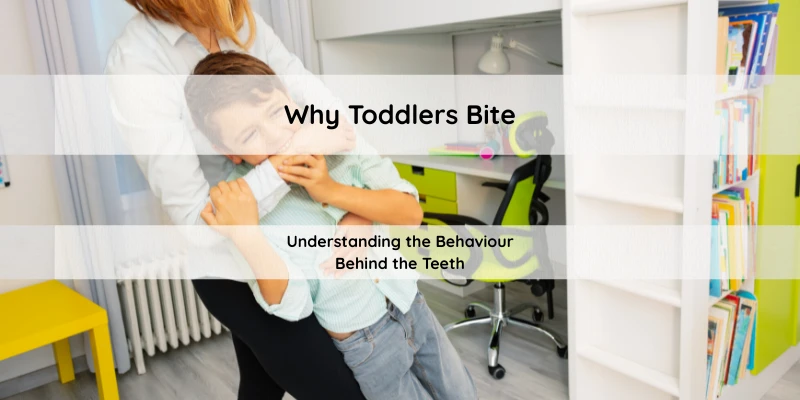
Why Toddlers Bite – Understanding the Behaviour Behind the Teeth
Few toddler behaviours create an adult reaction quite as quickly as biting.
If your toddler bites another child at childcare, bites a sibling during an argument or suddenly sinks their teeth into your arm, it can feel shocking. Parents often worry that the behaviour means their child is aggressive, deliberately hurting others or developing a serious behavioural problem.
In most cases, it means nothing of the sort.
Biting is a relatively common behaviour during the baby and toddler years, when children are still developing language, impulse control, emotional regulation and social skills. Raising Children Network describes biting, pinching and hair-pulling as behaviours that can occur as part of early development.
A toddler might bite because they are frustrated, overwhelmed, excited, curious, teething or unable to communicate quickly enough. The behaviour still needs a clear boundary — biting hurts — but understanding why toddlers bite makes it much easier to respond effectively.
Why do toddlers bite other people?
Toddlers are developing extraordinarily quickly, but many of the abilities adults rely on to manage conflict are still immature. Imagine another child takes a toy from a two-year-old. An adult might say, “I was using that. Can I have it back?” A toddler needs to recognise what has happened, manage the rush of frustration, remember an appropriate response, find the necessary words and inhibit the impulse to act physically.
That is a considerable developmental task. Sometimes the toddler’s body responds before those skills are available. They push. They hit. Or, they bite.
Toddler biting often happens in the gap between strong emotions and the child’s still-developing ability to express and regulate them. Toddlers continue to rely heavily on caregivers for support with emotional and social regulation while these abilities develop.
This does not mean biting should simply be ignored. It means the solution involves teaching and development rather than treating the toddler as deliberately malicious.
Is biting normal toddler behaviour?
Biting can occur during normal development, particularly during the first few years of life. Some toddlers never bite. Others go through a brief period in which biting becomes a regular response to frustration or excitement.
The behaviour can be particularly noticeable in childcare environments because toddlers are spending long periods close to other children while sharing toys, space and adult attention. The American Academy of Pediatrics notes that biting among groups of toddlers is common in childcare settings.
Developmentally common does not mean acceptable. Parents and educators can maintain a firm boundary without treating the behaviour as evidence that something is fundamentally wrong with the child.
Why does my toddler bite when they are angry?
Frustration is one of the most obvious triggers for biting.
Toddlers experience strong emotions but have limited capacity to regulate them independently. They are also learning language, which means their ability to explain what they want can lag behind the intensity of the feeling.
Your toddler might bite because:
- another child took something
- they were pushed
- they were told no
- somebody entered their play
- they could not make themselves understood
- they wanted something immediately
- they were expected to stop a preferred activity.
In these moments, biting can become an extremely fast way of communicating:
- “Stop.”
- “Mine.”
- “Move.”
- “I’m angry.”
- “I want that.”
The goal is therefore not only to stop the bite. Toddlers need adults to gradually give them safer ways to communicate the message that the bite was expressing.
Can toddlers bite because they cannot find the words?
Yes.
Language development and behaviour are closely connected during toddlerhood.
A child might know exactly what they want but have only a small vocabulary available. Even toddlers who speak relatively well can lose access to their words when they become highly upset.
This is why useful replacement language needs to be extremely simple.
Instead of expecting:
- “Please stop taking the truck because I was still playing with it.”
- a toddler might initially learn:
- “Mine.”
- “Stop.”
- “My turn.”
- “Help.”
- “No.”
Adults can model these words repeatedly during calm play as well as after conflict.
Teaching a toddler what to do instead of biting is usually more useful than repeatedly telling them only what not to do.
Why does my toddler bite when they are excited?
Biting is not always an expression of anger.
Some toddlers bite when they are excited, playful or affectionate. They might hug someone tightly and suddenly bite their shoulder, or become overstimulated during physical play and use their mouth before they have consciously decided what they are doing.
Young children are still learning how much physical force is appropriate and how their actions affect other people.
You can respond calmly and clearly, “Gentle mouth. Biting hurts.”
Then show the child what they can do instead: kiss, cuddle, clap, squeeze a cushion or use another safe physical action.
The emotional meaning of a bite matters: an excited bite and an angry bite may look similar but have different triggers.
Can teething make toddlers bite more?
Teething can contribute to biting because pressure on the gums can feel relieving.
A toddler might chew toys, clothing, fingers or other objects more frequently when teeth are emerging. Another child’s arm can unfortunately become one more available object.
Offering appropriate things to chew can help when oral discomfort appears to be part of the pattern.
However, teething does not explain every bite between children. If biting reliably occurs when toys are taken, during transitions or when the toddler becomes frustrated, the behaviour is likely serving a social or emotional function as well.
Can sensory needs cause toddler biting?
For some children, biting provides strong sensory feedback through the jaw and mouth.
These toddlers might also chew clothing, toys or other objects frequently. Biting might become more likely when they are overstimulated, tired or seeking strong sensory input.
This does not mean that frequent biting automatically indicates autism or a sensory processing condition.
Many toddlers explore with their mouths, and repetitive chewing can occur for several reasons.
If biting is one part of a broader pattern involving communication difficulties, unusually intense sensory responses, developmental concerns or other repetitive behaviours, parents can discuss the pattern with a GP or child-development professional.
Why does my toddler bite the same child repeatedly?
Parents can become particularly concerned when one child seems to be repeatedly targeted. This does not necessarily mean your toddler dislikes that child. Look at what repeatedly happens immediately before the bite. Perhaps the other child frequently enters their personal space. Perhaps both children compete for the same toys. Maybe your toddler bites during energetic play with this particular child because the interaction becomes overstimulating.
The key is to identify the pattern.
Repeated toddler biting is often easier to prevent when adults focus on the situation immediately before the bite rather than only on the behaviour afterwards.
Why does biting happen so often at childcare?
Childcare environments place significant demands on developing social skills.
Toddlers must share space, wait, transition between activities, tolerate noise, communicate with peers and manage competition for interesting objects.
They might also be more tired later in the day or have less individual adult support than they receive at home.
None of this means childcare causes biting. It simply creates many opportunities for the developmental skills behind biting to be tested.
A useful childcare response involves observing:
- When does the biting occur?
- What happened immediately beforehand?
- Is the child tired or hungry?
- Does it happen during crowded play?
- Does one particular transition trigger it?
- Is the child trying to obtain a toy?
- Does biting produce an immediate result?
Once a pattern becomes clear, educators can often intervene before teeth meet skin.
How should I respond when my toddler bites?
The immediate response should be calm, brief and clear.
Raising Children Network recommends staying calm and clearly saying no when a baby or toddler bites.
You might say:
- “Stop. Biting hurts.”
- Then attend to the child who was bitten.
- This matters because a dramatic reaction directed primarily towards the child who bit can inadvertently provide considerable attention around the behaviour.
- Once everyone is safe, help your toddler understand what they could do instead:
- “You wanted the truck. Say, ‘my turn’.”
- “You were angry. Come and get me.”
- “You wanted him to move. Say, ‘stop’.”
The most effective response to toddler biting combines a firm limit with teaching the alternative behaviour the child does not yet reliably have.
Should I make my toddler apologise after biting?
You can encourage repair, but forcing an automatic “sorry” from a very young child often achieves less than adults imagine.
A toddler might repeat the word without understanding the other child’s experience.
It can be more useful to model empathy, “Sam is crying because the bite hurt.”
Then help your child participate in repair where appropriate.
They might bring a cold pack, return a toy or sit nearby while the adult comforts the other child.
As language and perspective-taking develop, genuine apologies become more meaningful.
The goal is not to produce the correct word on command. It is to gradually teach the child that their actions affect other people and relationships can be repaired after someone is hurt.
Should I bite my toddler back so they understand?
No.
Biting a toddler back might certainly demonstrate that biting hurts, but it also demonstrates that adults use biting when they want to teach someone a lesson.
That is exactly the behavioural model parents are trying to replace.
Physical punishment and humiliation are not recommended approaches to managing childhood behaviour. The American Academy of Pediatrics recommends positive reinforcement, limit-setting and redirection rather than hitting, threatening or shaming children.
Toddlers learn much more from adults consistently modelling the behaviour they want the child to develop.
Should a toddler be punished for biting?
A toddler needs a consequence in the broad sense that biting immediately changes what happens. The adult stops the behaviour. The other child is protected. The toddler might temporarily move away from the interaction while everyone settles.
But severe punishment is unlikely to teach the developmental skills that were missing when the bite occurred.
The American Academy of Pediatrics advises against punishment for biting in childcare and instead recommends safe redirection and alternative physical activities when children are frustrated or angry.
Long lectures are also of limited value to a two-year-old who has already become overwhelmed.
The response should be immediate enough for the toddler to connect it with the behaviour, but calm enough to teach rather than frighten.
How can I stop my toddler from biting?
Prevention is often more effective than reacting after every bite.
Start looking for patterns:
- If biting happens when your child is hungry, provide food before the difficult part of the day.
- If biting appears during crowded play, give them more space.
- If it happens when another child takes a toy, remain nearby and help with turn-taking before frustration escalates.
- If transitions are difficult, provide a warning.
- If your toddler has limited language, practise simple phrases they can access quickly.
It can also help to notice the earliest signs that your child is becoming overloaded: grabbing, stiffening, shouting, moving closer to another child or becoming increasingly physical.
At that point, intervene.
“You’re getting frustrated. I’m going to help.”
Preventing toddler biting means recognising the sequence that leads to the bite and helping the child earlier in that sequence.
Why does my toddler keep biting even though they know it is wrong?
Knowing a rule and being able to follow it while emotionally activated are two different developmental abilities.
Your toddler might be able to tell you:
“No biting.”
They might even tell a toy:
“Biting hurts!”
Then bite someone the next afternoon.
This does not necessarily mean that they ignored everything you taught them.
Impulse control develops gradually. During frustration, excitement or fatigue, the child might act before the rule can guide their behaviour.
This is one reason repetition is such a major part of parenting toddlers.
A toddler can understand that biting is not allowed before they have developed the self-control needed to stop every bite.
Does biting mean my toddler is aggressive?
Not necessarily.
Biting is an aggressive action because it can hurt another person, but performing an aggressive action does not mean the child has an aggressive personality.
Toddlers are still developing empathy, language, inhibition and social problem-solving.
Avoid labels such as:
- “He’s a biter.”
- “She’s aggressive.”
- “He’s mean.”
A behavioural description is more useful:
“He has been biting when another child takes his toys, so we are helping him learn what to do instead.”
Behaviour describes something a toddler did; it should not become the identity adults give them.
What should childcare educators do when a toddler bites?
The immediate priorities are protecting the child who was bitten, providing appropriate first aid and calmly stopping further biting.
Educators should then document and observe the circumstances surrounding incidents.
Patterns can reveal useful information about transitions, peer interactions, fatigue, communication and the physical environment.
Parents and educators benefit from taking a collaborative approach rather than assigning blame.
A useful conversation sounds like:
“We’ve noticed biting tends to happen late in the afternoon when another child comes into his play. We’re going to stay closer at that time and help him use ‘stop’ before he gets overwhelmed.”
That is far more useful than:
“He was bad again today.”
Toddler biting is best addressed when families and educators treat it as a behaviour to understand and teach through rather than a character problem.
What should I do if another toddler bites my child?
It is understandable to feel upset when your child comes home with a bite mark.
Ask the service how the injury was treated and what steps are being taken to supervise and prevent repeated incidents.
At the same time, remember that childcare services have privacy obligations and might not be able to provide detailed information about the other child.
Repeated biting deserves active management, but it is rarely helpful to characterise another toddler as violent or dangerous based on biting alone.
If a bite breaks the skin or causes significant injury, appropriate first aid and medical advice might be needed. The AAP notes that bites involving broken skin or prolonged bleeding can require assessment by a health professional.
When should I be concerned about toddler biting?
Occasional biting during toddlerhood is usually not, by itself, evidence of a developmental or behavioural disorder.
It is worth seeking additional advice when:
- biting is extremely frequent or severe
- the behaviour continues despite consistent intervention
- your child regularly causes significant injuries
- biting occurs alongside substantial communication delays
- your toddler has broader developmental difficulties
- the behaviour appears highly compulsive or difficult to interrupt
- biting remains prominent well beyond the age when it is typically expected
- you or your childcare service cannot identify ways to keep other children safe.
A GP, child health nurse, paediatrician, psychologist or other developmental professional can help examine the broader picture.
Concern should increase when biting is part of a larger pattern of developmental or behavioural difficulty rather than because one isolated behaviour has been labelled abnormal.
Will my toddler grow out of biting?
For many children, biting decreases as language, impulse control and emotional regulation improve.
The child gradually becomes better able to say:
- “Stop.”
- “Help.”
- “I’m angry.”
- “My turn.”
They also become increasingly able to pause before acting and understand how their behaviour affects another person.
Adults play an important role in that development.
Every calm interruption, every modelled word and every successful moment in which your toddler becomes frustrated without biting is part of the learning process.
Biting can feel dramatic because teeth leave visible evidence of a toddler’s difficult moment.
But behind those teeth is usually a very young child trying to manage strong sensations, feelings and social situations with a nervous system that is still under construction.
The aim is not simply to stop toddlers from biting. It is to help them develop the communication, emotional regulation and self-control that eventually make biting unnecessary.
Where can I learn more about toddler behaviour?
If biting is occurring alongside tantrums, hitting or other intense emotional reactions, our child behaviour resources explain how emotional regulation develops and why toddlers often rely on adults to help them manage overwhelming feelings.
You can also visit the Child Care Guide Blog for more evidence-based articles about toddler behaviour, child development, emotional regulation and parenting.
Reviewed and updated: 8 August 2026