Too Many Choices Can Make Children Anxious — Here’s Why
Giving children choices sounds like good parenting. And often, it is. Choices can give children a sense of independence, help them practise decision-making and reduce unnecessary power struggles. But there is a point where offering more choice stops being helpful and starts making things harder.
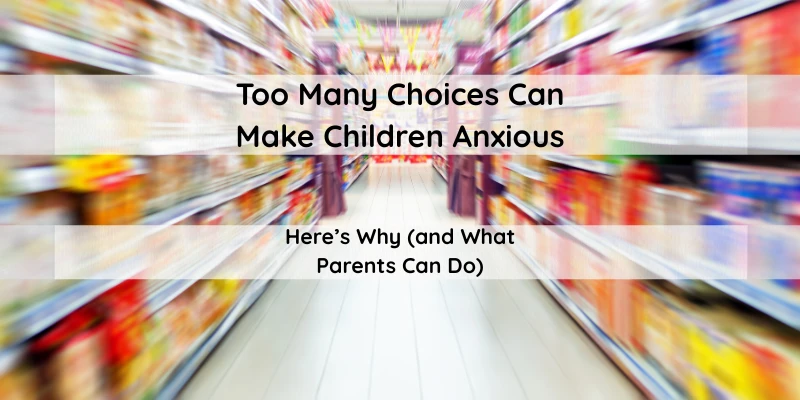
As adults, most of us know the feeling of standing in front of the cereal aisle — an entire wall of boxes, colours, promises, and price tags — and suddenly feeling stuck. There are too many options. What should be a simple decision becomes uncomfortable or stressful.
For a young child, even everyday decisions can sometimes feel like this.
Too many choices can overwhelm children because their decision-making, working-memory and emotional-regulation skills are still developing.
The answer is not to remove choice altogether. It is to give children the right amount of choice for their age and their ability to cope in that moment.
Why can too many choices overwhelm children?
Making a decision requires more brainpower than it might appear.
If you ask, “What do you want to wear today?”, your child potentially has to think about every shirt, pair of shorts, dress, jumper and pair of shoes available.
They then need to compare those options, imagine the result, decide what matters and finally commit to one choice.
Adults perform many of these mental steps automatically.
Young children do not.
The brain systems involved in planning, organising, holding information in mind and controlling impulses are still developing throughout childhood and adolescence.
This means an apparently generous question can sometimes create more cognitive work than the child is ready to manage.
What is choice overload?
Choice overload describes what can happen when having many possible options makes choosing more difficult rather than easier.
More choice does not automatically cause anxiety, and people respond differently depending on the situation. But when the number of options becomes difficult to compare, decisions can become slower, more frustrating and more mentally demanding.
Children can be particularly vulnerable because their ability to organise and evaluate several possibilities is still developing.
A toddler choosing between two shirts has a manageable problem.
A toddler being told to choose anything they want from an entire wardrobe has a much bigger one.
Choice is most useful when a child has enough options to experience autonomy without so many that deciding becomes a task in itself.
Why are choices harder when children are already tired or upset?
A child’s capacity to make decisions changes throughout the day.
A choice that is easy at 10 o’clock in the morning might become impossible just before bedtime.
When children are tired, hungry, anxious, frustrated or overstimulated, they have fewer mental resources available for planning and self-control.
This is why asking, “What do you want for dinner?” can sometimes produce an immediate “I DON’T KNOW!”
The problem might not be the dinner.
The child might simply have reached the point where one more decision feels like too much.
When children are already emotionally overloaded, reducing demands can be more helpful than offering additional choices.
Why do choices sometimes make transitions worse?
Transitions already require considerable mental flexibility.
A child has to stop one activity, disengage their attention, understand what is happening next and begin something different.
Consider the transition from play to getting ready for childcare.
Your child already has to stop playing, find their belongings, get dressed and leave the house.
If you then ask:
- “What do you want to wear?”
- “Which shoes do you want?”
- “What do you want for breakfast?”
- “Which cup would you like?”
each question adds another decision to an already demanding sequence.
For some children, this is manageable. For others, it creates the conditions for frustration, delay or a meltdown.
Reducing unnecessary decisions during difficult transitions can make routines much easier for young children to manage.
How many choices should parents give a young child?
There is no magic number, but two choices is often a useful starting point for toddlers and preschool children.
Instead of:
“What do you want for breakfast?”
try:
“Would you like toast or Weet-Bix?”
Instead of:
“What do you want to wear?”
try:
“Blue shirt or green shirt?”
Instead of:
“What should we do before bed?”
try:
“Would you like the dinosaur book or the bear book?”
Both options should be acceptable to you.
This is sometimes called a bounded choice: the adult sets the limits while the child has meaningful control within them.
What if my child refuses both choices?
This happens frequently.
You offer, “Blue shoes or red shoes?” Your toddler replies, “NO SHOES!”
The important thing is remembering that a choice does not make a necessary task optional.
You can calmly say, “You don’t want either. We need shoes to go outside. You can choose, or I can choose for you.”
Then follow through.
Giving children choices does not mean giving them control over every family decision.
The adult remains responsible for safety, routines and appropriate boundaries.
When should parents make the decision instead?
Sometimes the kindest option is simply to decide.
If your child is exhausted, distressed or running late, they might not benefit from being asked to make another choice.
You can say:
“We’re having toast this morning.”
or:
“I’ve put your blue clothes out today.”
This is not denying your child autonomy.
Children do not need responsibility for every minor decision in order to develop independence.
In fact, predictable adult leadership can reduce stress because the child does not have to work everything out for themselves.
You can provide more opportunities for choice later, when there is time and emotional capacity to manage them.
Can routines reduce decision overload?
Yes.
Routines remove decisions that do not need to be made repeatedly. If bath comes after dinner and books come after pyjamas, the child does not need to negotiate the sequence every evening.
Visual routines can be especially useful for young children because they make the next step easy to see.
A morning routine might show:
Get dressed → Eat breakfast → Brush teeth → Shoes → Leave.
Predictability reduces the amount of information a child has to organise and can make transitions feel safer and more manageable.
Are choices still important for children?
Absolutely.
The goal is not to create a childhood in which adults make every decision. Children need opportunities to develop preferences, make decisions and experience appropriate control over their lives.
Useful choices might include:
- “Apple or banana?”
- “Would you like to walk or hold my hand?”
- “Bath first or pyjamas first?”
- “Which book should we read?”
As children develop, the number and complexity of decisions can gradually increase.
Healthy autonomy grows through manageable choices, not unlimited choice.
What is the easiest rule for parents to remember?
Try this:
When your child is calm, offer choice. When your child is overwhelmed, offer structure.
Sometimes your child needs independence. Sometimes they need you to narrow the possibilities. And sometimes they simply need an adult to make the decision and help them move on.
Giving fewer choices is not about controlling children. It is about recognising that decision-making is a developmental skill — and making the world manageable enough for that skill to grow.
Where can I learn more about children’s behaviour and anxiety?
If your child frequently becomes overwhelmed by uncertainty, avoids unfamiliar situations or needs repeated reassurance, our Anxiety in Children guide explains how childhood anxiety can appear and when additional support might be helpful.
You can also explore the Child Care Guide Blog for more practical articles about child behaviour, emotional regulation, development and parenting.
Reviewed and updated: 8 August 2026