Why Counting to Ten Can Help a Child Calm Down
“Count to ten.”
It is one of the oldest pieces of advice for dealing with anger or frustration, and it can sound almost too simple to be useful.
But there is a good reason that slow counting can sometimes help an overwhelmed child.
When children become highly upset, their attention narrows around whatever feels threatening, frustrating or unfair. Thinking clearly, remembering instructions and controlling impulses all become harder.
Slow counting gives the child something simple, predictable and organised to focus on while their emotional arousal begins to settle.
It is not a magical neurological reset button, and it will not stop every meltdown. But used at the right moment — particularly alongside a calm adult and slower breathing — counting can become a useful emotional-regulation tool.
What is an “amygdala hijack”?
The phrase amygdala hijack was popularised by psychologist Daniel Goleman as a way of describing moments when an intense emotional reaction seems to take control before thoughtful reasoning can catch up.
The amygdala is involved in detecting emotionally significant information, particularly possible threats. But it does not work alone. Emotional responses involve interconnected brain systems, including areas of the prefrontal cortex that contribute to attention, decision-making and regulation. These regulatory systems continue developing throughout childhood.
When a child becomes extremely angry, frightened or overwhelmed, they might find it much harder to:
- listen carefully
- remember what you have just said
- consider consequences
- solve a problem
- shift their attention
- control an immediate impulse.
This is why asking an overwhelmed five-year-old, “Why did you do that when you know better?” often produces very little useful information.
The child might know the rule perfectly well when calm but have much less access to thoughtful self-control while highly distressed.
Why can counting help an overwhelmed child?
Counting creates a simple cognitive task.
To count slowly from one to ten, the child needs to direct attention towards a predictable sequence:
One.
Two.
Three.
Four.
That sequence gives the mind something structured to follow instead of remaining completely absorbed in the emotional trigger.
Counting also naturally introduces a pause.
Instead of moving immediately from:
“I’m angry”
to:
“I hit,”
there is an opportunity for something else to happen in between.
That pause is often the useful part of counting.
It gives emotional arousal time to begin changing and provides an opportunity for the child’s developing self-regulation skills to re-engage.
Why does slow counting work better than rushing to ten?
The point is not simply to reach the number ten.
“One-two-three-four-five-six-seven-eight-nine-ten!”
is unlikely to change much.
Slow counting is more useful because it encourages the child to pause.
If you count together:
“One …”
pause.
“Two …”
pause.
“Three …”
the rhythm can also encourage slower breathing.
Slow voluntary breathing has measurable effects on autonomic regulation and heart-rate variability, including processes associated with parasympathetic activity — the systems involved in settling the body after arousal.
So the benefit might come from several things happening together:
attention shifts, the child pauses, breathing slows and the emotional reaction has time to lose some of its intensity.
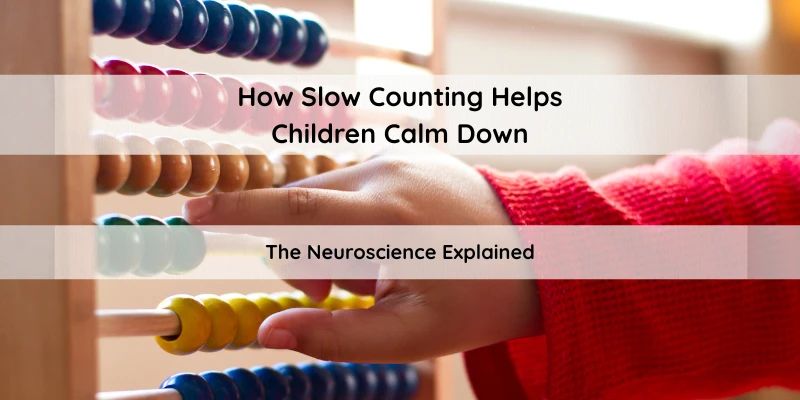
Why can counting objects work even better?
For some children, simply saying numbers is too abstract when they are upset.
Physical objects can make the task easier.
You might count:
- LEGO bricks
- pebbles
- toy cars
- buttons
- blocks
- shells
- fingers.
The child now has something to look at, something to touch and something predictable to do.
“Move one block over here.”
“One.”
“Now another.”
“Two.”
This can function as a form of grounding because attention is redirected towards something happening in the present moment.
The physical task also removes some of the pressure to talk about the emotion immediately.
A child who cannot yet explain why they are overwhelmed might still be able to touch, move and count objects with a trusted adult.
Why doesn’t saying “calm down” usually work?
“Calm down” describes the result you want.
It does not tell the child how to achieve it.
Imagine someone telling you:
“Stop being anxious.”
Unless you already know how to regulate yourself, the instruction provides very little practical help.
Young children are still developing those skills.
They often need co-regulation, meaning a calmer adult helps them manage strong emotions before they can reliably do it independently. Developmental guidance emphasises that children frequently need adult support to notice emotions, pause and settle before addressing the underlying problem.
Instead of:
“Calm down!”
you might say:
“You’re really upset. Come here. Let’s count these blocks together.”
Now the child has something concrete to do.
Will counting work during every meltdown?
No.
This is important.
If your child is already extremely distressed — screaming, running away, hitting or unable to engage with you — asking them to count might simply become another demand.
In that moment, the priority might be:
keeping everyone safe,
reducing noise and stimulation,
using very few words,
and allowing the child time to settle with your support.
Regulation strategies work best when the child is still able to engage with them.
Counting might therefore work better when you notice the emotion building rather than waiting until the child has completely lost control.
How can parents teach counting as a calming strategy?
Practise it when your child is calm.
That might sound strange, but children are much better at learning regulation skills when they are not already overwhelmed.
You could occasionally say:
“Let’s practise our slow counting.”
Move ten blocks one at a time.
“One … two … three …”
Keep your voice relaxed.
You can also combine counting with breathing:
“Breathe in … one.”
“Breathe out … two.”
The exact method matters less than making it familiar.
Then, when your child begins becoming frustrated, you can say:
“Your body is getting really worked up. Want to do our slow count?”
The strategy is no longer something completely new being introduced during a difficult moment.
Should I force my child to count when they are angry?
No.
Turning a calming strategy into a command can defeat its purpose.
“You WILL sit there and count to ten!”
is unlikely to feel regulating.
You can invite and model instead:
“I’m going to count slowly with you.”
If the child refuses, reduce your language and focus on helping them become safe and settled.
Different children also respond to different strategies.
One child might like counting.
Another might prefer movement.
Another might need quiet.
Another might respond better to holding something cold, squeezing a cushion or simply sitting near a calm parent.
Emotional regulation is not about finding one trick that works for every child; it is about building a collection of strategies that the individual child can gradually learn to use.
What should happen after the child calms down?
Counting does not solve whatever caused the emotion.
It simply creates enough regulation for problem-solving to become possible.
Once your child is calmer, you can return to what happened:
“You were angry because your brother took the truck.”
Then help them think about an alternative:
“Next time you can say, ‘Stop, I’m using it,’ or come and get me.”
This is where the real learning happens.
Calm first. Teach second.
Trying to reverse that order is one of the main reasons reasoning with an overwhelmed child so often fails.
A simple way to remember it
Slow counting can help because it gives an overwhelmed child:
a focus, a rhythm, a pause and time to regulate.
It does not literally switch off the emotional brain or magically switch the thinking brain back on.
Instead, it gives the child a simple activity that can support attention and slower breathing while a calm adult provides co-regulation.
And for some children, that small pause is enough to change what happens next.
Where can I learn more about emotional regulation?
If your child frequently experiences intense tantrums, meltdowns or difficulty recovering from strong feelings, explore the Child Care Guide Blog for more practical articles about child behaviour, emotional regulation and development.
You can also visit our Child Mental Health guide for information about anxiety, ADHD and other conditions that can affect children’s emotional regulation.
Reviewed and updated: 11 August 2026