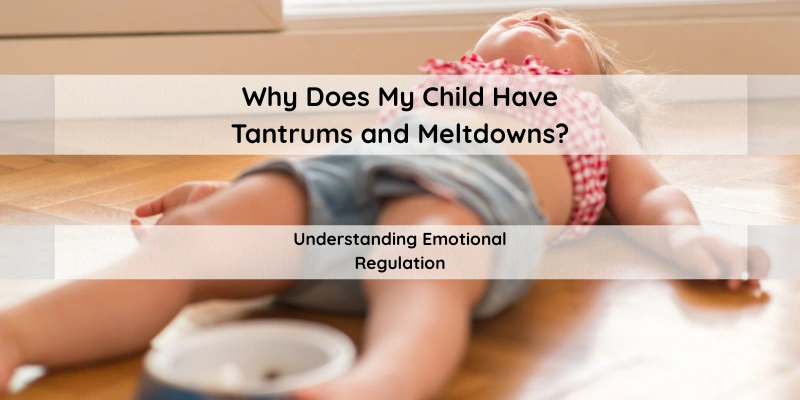
Why Does My Child Have Tantrums and Meltdowns? Understanding Emotional Regulation
Tantrums and meltdowns can be exhausting for parents.
One moment your child seems fine. The next, they are screaming because the wrong cup was used, refusing to leave the playground or collapsing on the floor because it is time to get dressed.
It can feel as though the reaction has come from nowhere.
Usually, it hasn’t.
Tantrums and meltdowns often happen when a child’s emotions, frustration or sensory demands exceed the self-regulation skills they can access in that moment. Young children are still developing the ability to manage strong emotions, shift attention, tolerate disappointment and control impulses. Tantrums are especially common during the toddler years for exactly this reason.
Understanding this does not mean allowing children to hit, throw things or ignore every boundary. It means recognising that an overwhelmed child usually needs help becoming regulated before they can learn from what happened.
Why do young children have so many tantrums?
Toddlers and preschoolers feel powerful emotions long before they have adult-like skills for managing them.
They can become intensely angry because a sibling took a toy, devastated because a banana broke in half or furious because they cannot put their shoes on independently.
To an adult, the problem might seem tiny.
To the child, the frustration is immediate and real.
At the same time, young children are still developing language, impulse control, flexible thinking and emotional regulation. Executive-function skills such as working memory, mental flexibility and self-control develop gradually rather than arriving fully formed.
A tantrum often reflects a mismatch between the size of the emotion and the child’s current ability to manage it.
This is why tantrums usually become less frequent as children develop stronger language and self-regulation skills.
Does the “thinking brain” really switch off during a tantrum?
Not literally.
You might hear that a child’s “thinking brain goes offline” during a meltdown. It is a useful shorthand, but the neuroscience is more complex.
When children become highly emotionally aroused, skills such as listening, reasoning, remembering instructions and controlling impulses become harder to use effectively.
The child still has access to their brain, but their capacity for organised thinking is reduced while they are overwhelmed.
That is why lengthy explanations often fail during the peak of a tantrum.
Imagine saying:
“We discussed this yesterday. You know that when we come to the shops you can choose only one thing, and screaming is not going to change my mind.”
The child might technically hear every word.
But they are unlikely to process it in the thoughtful way you intend.
A short statement is usually more useful:
“You’re really disappointed. We’re not buying it today.”
The teaching conversation can come later.
What role does the amygdala play in emotional outbursts?
The amygdala is involved in detecting emotionally significant information, including possible danger.
It works with many other brain systems involved in memory, attention, emotion and regulation.
When a child becomes frightened, frustrated or overwhelmed, their nervous system can shift into a heightened state of arousal. Their heart might beat faster, muscles tense and behaviour become more reactive.
You might see:
- shouting
- crying
- running away
- hitting
- kicking
- freezing
- clinging
- throwing objects.
The term “amygdala hijack” is sometimes used to describe moments when a strong emotional response seems to occur before reflective thinking has caught up.
It is better understood as a metaphor than a literal brain takeover.
Strong emotions can temporarily make self-control harder, particularly in a young brain whose regulatory systems are still developing.
What is the difference between a tantrum and a meltdown?
The words are often used interchangeably, but they can describe somewhat different experiences.
A tantrum usually occurs around frustration, disappointment, a limit or an unmet desire.
A toddler might scream because they want another biscuit or because it is time to leave the playground.
Tantrums are common during early childhood and are part of normal emotional development.
A meltdown generally refers to a more complete loss of behavioural control caused by overwhelming emotional, sensory or cognitive demands. The term is particularly common when discussing autistic children, where meltdowns can occur when the child becomes completely overwhelmed and finds it extremely difficult to regain control.
The distinction is not always perfectly clear in real life.
A frustrated tantrum can escalate until the child is genuinely overwhelmed.
What matters most is recognising the child’s current capacity.
Whether you call it a tantrum or a meltdown, once a child is deeply dysregulated, reducing arousal is usually more useful than arguing about the original demand.
Are tantrums deliberate?
Sometimes children do learn that certain behaviours affect what adults do.
A toddler might scream because previous screaming has resulted in receiving the biscuit they wanted.
That does not mean the emotional reaction is fake.
Behaviour and emotion can coexist.
A child can genuinely be furious while also learning from what happens afterwards.
This is why parents need both empathy and boundaries.
You can acknowledge:
“You really wanted another biscuit.”
while maintaining:
“We’re finished with biscuits today.”
Understanding emotional regulation should not mean that every tantrum results in the child getting what they wanted.
Children can be genuinely overwhelmed while still learning which behaviours do and do not change a boundary.
Why does my child melt down over tiny things?
Sometimes the final trigger really is tiny.
But it might be only the final part of a much bigger load.
Imagine your child’s emotional capacity as a cup.
Throughout the day, the cup gradually fills with:
- noise,
- transitions,
- hunger,
- fatigue,
- social demands,
- frustration,
- waiting,
- sensory stimulation,
- effort spent following instructions.
Then you hand them the wrong coloured cup.
The cup spills.
To the parent, the reaction seems completely disproportionate to what just happened.
But the wrong cup might represent only the final demand placed on a nervous system that was already struggling.
Small triggers can cause enormous reactions when a child has very little regulatory capacity left.
This is why tantrums often increase late in the day or after childcare and school.
Why are tantrums worse when my child is hungry or tired?
Emotional regulation takes effort.
When children are tired, hungry, sick or overstimulated, fewer resources are available for patience and self-control.
A child who could tolerate disappointment easily after breakfast might find the same disappointment impossible shortly before dinner.
This does not mean every tantrum can be prevented with a snack or nap.
It means physical needs influence emotional capacity.
When tantrums suddenly increase, it can help to ask:
- When did they last eat?
- How much sleep did they get?
- Has today involved more noise or activity than usual?
- Are they becoming unwell?
Sometimes the most effective behaviour intervention begins with meeting a physical need.
Why are transitions such a common trigger?
Stopping one activity and beginning another requires several developing skills.
The child has to disengage attention, tolerate the loss of something enjoyable, understand what comes next and reorganise behaviour around the new task.
That is a lot to ask of a toddler.
Transitions such as:
- leaving the playground,
- turning off a screen,
- going to childcare,
- having a bath,
- getting dressed,
- beginning bedtime
can therefore become regular flashpoints.
Advance warning often helps.
“Five more minutes, then bath.”
Then:
“Two more minutes.”
Predictable routines can also reduce the surprise involved.
Children often cope better with transitions when they know that change is coming and what will happen next.
Can sensory overload cause meltdowns?
Yes.
Some children become overwhelmed by high levels of sensory input.
A busy shopping centre might involve fluorescent lighting, music, trolley noise, conversations, smells, crowds and constant movement.
A child who is particularly sensitive to sensory information might cope for a while and then suddenly become unable to manage any more.
The resulting behaviour can look like a tantrum but might be driven primarily by overload.
Reducing stimulation can help:
- move somewhere quieter,
- dim lights where possible,
- reduce the number of people speaking,
- offer headphones if the child uses them,
- provide physical space.
When meltdowns repeatedly occur in particular environments, look at what the child is experiencing through their senses as well as what they are being asked to do.
What should parents do during a tantrum or meltdown?
Start with safety.
Prevent hitting, biting, throwing dangerous objects or running into unsafe areas.
Then reduce the amount of language you use.
Children who are extremely upset usually cannot process a lecture.
Try simple statements:
- “You’re very angry.”
- “I’m here.”
- “I won’t let you hit.”
- “We’ll talk when you’re calmer.”
Raising Children Network recommends noticing and naming strong emotions, pausing and supporting children to calm before addressing the problem itself.
During intense dysregulation, your first job is not to teach the lesson. It is to help create the conditions in which learning becomes possible again.
Should I hug my child during a meltdown?
It depends on the child.
Some children actively seek physical contact when overwhelmed and calm more quickly with a cuddle, sitting on a parent’s lap or firm reassuring contact.
Others find touch unbearable when highly aroused and need more physical space.
Watch your child’s cues.
You might offer:
“Do you want a cuddle or some space?”
For a younger child who cannot answer, stay nearby and observe whether your approach seems to increase or decrease distress.
Co-regulation does not always mean physical contact; sometimes it means being a calm, predictable presence nearby.
What is co-regulation?
Co-regulation describes the way children develop emotional regulation with support from other people.
Young children do not simply teach themselves how to cope with overwhelming emotions.
Adults help by:
- remaining calm,
- providing predictable boundaries,
- naming emotions,
- reducing unnecessary stimulation,
- modelling ways of recovering.
Over time, the child gradually internalises more of these skills.
Executive function and self-regulation develop through experience and practice rather than being fully present from birth.
Children learn self-regulation partly through repeated experiences of being helped to regulate.
Why does telling my child to “calm down” not work?
Because “calm down” describes the outcome rather than the process.
The child already needs help doing the thing you have asked them to do.
It is similar to telling someone:
- “Concentrate.”
- “Stop worrying.”
- “Go to sleep.”
The instruction itself does not provide the missing skill.
Instead, give the child something concrete:
- “Sit beside me.”
- “Let’s breathe slowly.”
- “Have a drink.”
- “Let’s count together.”
- “Come somewhere quieter.”
The exact strategy will vary between children.
Children develop emotional regulation by practising specific ways of settling, not simply by being told that they should be calm.
Should I give in to stop the tantrum?
Usually not when the original boundary was reasonable.
If the child learns:
I scream → the boundary disappears,
the tantrum can become more likely in similar situations.
You can remain emotionally supportive without changing the answer.
“I know you really wanted another episode. It’s hard to stop. The television is still finished.”
This is a crucial distinction.
Comforting a distressed child does not require removing the boundary that caused the distress.
The child is allowed to dislike the limit.
Your job is to help them cope with it.
Should I ignore tantrums?
It depends on what “ignore” means.
Ignoring dangerous behaviour is not appropriate.
Ignoring the child’s emotional experience can also leave them without support.
But parents do not need to provide intense attention to every scream, argument or demand.
You can stay nearby, keep the boundary clear and reduce unnecessary discussion.
For example:
“I hear you. The answer is still no. I’m here when you’re ready.”
This avoids turning the tantrum into a prolonged negotiation while still providing emotional availability.
What should happen after the tantrum is over?
Once the child is genuinely calm, keep the conversation short and useful.
Name what happened:
“You were very angry when it was time to leave.”
Then teach the alternative:
“Next time you can say, ‘one more turn please’.”
If someone was hurt, help the child repair the relationship.
You might also identify what would help next time:
“We’ll use the timer before we leave the playground.”
Children learn more from these calm conversations than from lectures delivered while they are screaming.
Regulate first, reflect second, practise third.
Can parents prevent tantrums?
Not all of them.
Tantrums are part of normal development, particularly during toddlerhood.
But parents can often reduce their frequency by noticing predictable triggers.
Helpful strategies include:
- maintaining regular meals and sleep
- preparing children for transitions
- providing age-appropriate choices
- keeping routines predictable
- avoiding unnecessary demands when the child is exhausted
- teaching simple emotion words
- providing opportunities for movement
- noticing early signs of overload.
Prevention is not about creating a life in which children never become frustrated.
Children need manageable experiences of frustration so they can gradually learn how to cope with them.
When should I be concerned about tantrums or meltdowns?
Frequent tantrums are common in toddlers, but professional advice can be useful when emotional outbursts are unusually severe, persistent or interfering significantly with everyday life.
Consider discussing the pattern with a GP or child health professional if your child:
- regularly injures themselves or others,
- has very prolonged or frequent episodes,
- cannot recover even with substantial support,
- experiences major difficulties at childcare or school,
- has significant communication delays,
- shows marked sensory difficulties,
- has lost previously established skills,
- has other developmental or mental health concerns.
Persistent emotional and behavioural changes can sometimes indicate that a child needs additional support. Healthdirect recommends seeking help when emotional or behavioural difficulties are ongoing or significantly affecting the child and family.
Parents do not need to decide whether an episode is technically a tantrum or a meltdown before asking for help. The impact on the child and family is what matters.
What should parents remember about tantrums and emotional regulation?
Tantrums are not evidence that you have failed as a parent.
Nor are they automatically proof that your child is deliberately misbehaving.
They are often moments in which a developing child has reached the limit of what they can regulate.
That child still needs boundaries.
They still need to learn safer behaviour.
But those lessons are most effective when adults recognise the developmental reality underneath the outburst.
Children gradually learn emotional regulation through development, repeated practice and the experience of calm adults helping them through emotions they cannot yet manage alone.
Your goal is not to prevent your child from ever becoming angry, disappointed or overwhelmed.
It is to help them slowly develop the capacity to experience those feelings without being completely controlled by them.
Where can I learn more about emotional regulation?
For a broader explanation of how stress, sensory information and developing brain systems influence behaviour, read How a Child’s Nervous System Shapes Behaviour and Emotions.
You might also find Why Counting to Ten Can Help a Child Calm Down useful for understanding one simple regulation strategy.
For more parent-friendly articles about tantrums, child behaviour and development, visit the Child Care Guide Blog.
Reviewed and updated: 14 August 2026