
How to Write a Learning Story
Learning stories are one of the most meaningful and authentic ways early childhood educators document children’s learning. Unlike checklists or brief anecdotal notes, a learning story captures the richness of an experience: the child’s actions, thinking processes, emotions, social interactions, and developing learning dispositions.
For students and new educators learning how to write a learning story, it is important to understand that these narratives are written for families to help them see and understand their child’s learning. Because the audience is the parent, learning stories are written in third person (e.g., “Ava explored…”, not “You explored…”). They are warm, descriptive, professional, and grounded in the Early Years Learning Framework (EYLF).
This guide explains what a learning story is, how to write one well, how to link learning to EYLF outcomes meaningfully, and provides examples, templates, and educator tips.
What Is a Learning Story?
A learning story is a narrative-style observation that describes a significant moment in a child’s play or learning. It highlights:
- what the child did,
- what learning occurred,
- why the moment was significant,
- how it links to the EYLF, and
- what educators will do next to extend the learning.
Learning stories are strengths-based and focus on the child’s abilities, interests, dispositions, and progress. They support high-quality assessment for learning by helping educators build a picture of a child’s development over time.
Why Learning Stories Matter
1. They make learning visible for families
The purpose of learning stories is communication. They translate everyday play into meaningful learning language that families can understand. Parents see not just a description of what happened, but why it mattered developmentally.
2. They support ongoing assessment
Multiple stories build a longitudinal record of a child’s identity, well-being, communication skills, and learning dispositions. This helps educators plan intentional experiences and adjust the program.
3. They capture learning dispositions
This includes curiosity, confidence, resilience, cooperation, creativity, perseverance, and problem-solving—qualities that are essential for lifelong learning.
4. They align with EYLF principles
Learning stories demonstrate:
- secure relationships
- play-based learning
- intentional teaching
- cultural responsiveness
- assessment for learning
5. They are flexible and educator-friendly
Learning stories can be short or long, written for individuals or groups, and tailored to reflect each service’s documentation philosophy.
How to Write a Learning Story (Step by Step)
Step 1: Observe and Choose a Meaningful Moment
The learning story begins with a real observation. This should be a moment that reveals learning or progress—not just an activity.
Look for:
- problem-solving attempts
- emerging skills
- social interactions or conflict resolution
- creative or imaginative play
- communication and language use
- persistence or resilience
- independence and agency
Example of a meaningful moment:
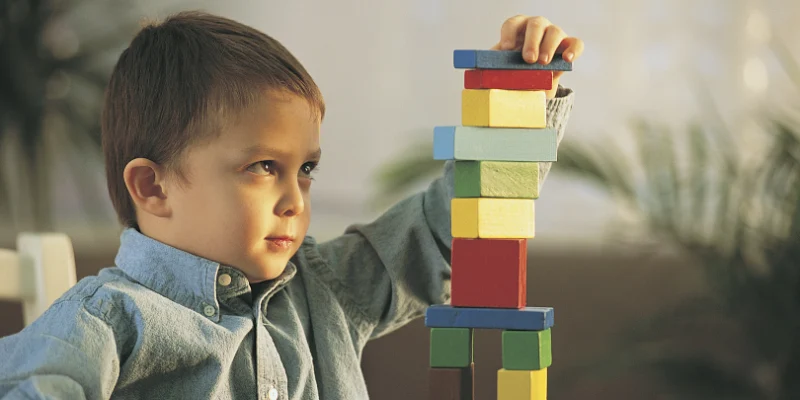
Noah designed a tall block tower, adjusting pieces each time it wobbled and discussing balance and height with a peer.
Step 2: Write a Warm, Narrative Description
The narrative section sets the scene and describes what occurred in clear, descriptive language. The goal is for the parent to visualise the moment.
A strong narrative includes:
- context (where it happened)
- materials the child used
- the child’s actions
- the child’s words or expressions
- interactions with peers or educators
- emotional tone
This section should be factual (what you saw/heard) but written with warmth and professionalism.
Narrative example:
During outdoor play, Noah began collecting a range of wooden blocks and carefully arranged the largest pieces at the bottom. As he added height, he tapped each block lightly to test its balance. When the tower leaned, Noah stepped back and announced, “It needs a stronger base!” He removed the top blocks and tried a different arrangement. Throughout the process he chatted with Leo, sharing ideas and inviting suggestions.
Step 3: Analyse the Learning
This is the part students often find hardest — but it is crucial.
Here you explain:
- what learning occurred,
- how you know,
- which dispositions were shown, and
- why the moment is significant.
This turns the narrative into assessment.
Expand the dot points into meaningful commentary:
- Problem-solving: Describe how the child experimented, tested, or revised their ideas.
- Social learning: Identify turn-taking, collaboration, negotiation, empathy, or shared meaning-making.
- Communication: Note specific vocabulary, storytelling, questioning, or expressive language.
- Emotional regulation: Explain how the child handled frustration, persistence, or confidence.
- Physical skills: Identify fine-motor or gross-motor development and how it supported the play.
- Creativity: Highlight original ideas or imaginative transformations of materials.
Example of a detailed analysis:
Noah demonstrated strong problem-solving skills by testing different methods of stabilising the tower and evaluating the results. His comments showed early STEM thinking, including concepts of balance, weight distribution and structure. Noah also displayed social competence as he involved Leo in the process, listened to suggestions, and used language to communicate his reasoning.
Step 4: Link the Learning to EYLF Outcomes (Meaningfully)
EYLF links should never be random or “copied and pasted.”
They must be:
- specific,
- justified,
- directly tied to the narrative, and
- written in full sentences explaining how the outcome was demonstrated.
How to link to EYLF effectively:
Outcome 1: Identity
- Appears when the child shows confidence, agency, resilience, autonomy, or willingness to explore.
- Example: Noah displayed increasing confidence and perseverance as he adjusted his block tower and persisted through challenges.
Outcome 2: Community
- Appears through cooperation, inclusion, teamwork, respect or shared decision-making.
- Example: By inviting Leo into the play and sharing ideas, Noah contributed to a collaborative learning experience.
Outcome 3: Wellbeing
- Appears through physical coordination, spatial awareness, emotional regulation, safety awareness.
- Example: Noah used coordinated gross-motor movements to balance and stack blocks while managing frustration calmly.
Outcome 4: Learning
- Appears through problem-solving, investigating, experimenting, predicting, testing and refining ideas.
- Example: Noah engaged in sustained problem-solving, testing multiple theories related to stability and structure.
Outcome 5: Communication
- Appears through verbal language, non-verbal communication, literacy, symbolic meaning-making.
- Example: Noah used descriptive language to explain his thinking and engaged in dialogue to share ideas with his peer.
Important:
Use only the most relevant 1–3 outcomes.
Linking to all five outcomes weakens the assessment and is not best practice.
Step 5: Plan Next Steps for Learning
Next steps must be:
- specific
- intentional
- achievable
- directly connected to the observed learning
Explain how you will extend the interest or ability.
Examples of expanded next steps:
- STEM extension: Offer different materials (PVC pipes, tubes, recycled boxes) to explore structure and stability.
- Vocabulary enrichment: Introduce words such as “support,” “gravity,” “foundation,” and “height.”
- Social skills extension: Encourage small-group construction challenges.
- Documentation extension: Take photos and invite the child to explain their design for a display panel.
Step 6: Invite Family Input (Optional but Recommended)
As learning stories are communication tools, you can include a gentle prompt inviting families to share what they see at home.
Example:
We welcome any stories from home about Noah’s interest in building or constructing. Your insights help us plan future learning experiences.
Expanded Learning Story Example
Title: Engineering in the Block Corner
Narrative:
During morning indoor play, Ava gathered a set of wooden planks and began building what she described as “a long bridge for the animals.” She arranged planks in a line, adjusting each one to make sure the surfaces touched evenly. When a plank shifted, Ava paused, crouched down to eye level with the blocks, and repositioned it with gentle taps. She explained to her peers that the bridge “has to be strong enough for the big animals too,” demonstrating early reasoning. She welcomed Olivia into the play and discussed how they might make the bridge wider.
Analysis of Learning:
Ava showed deep engagement and problem-solving skills as she experimented with ways to stabilise the planks. Her decision-making revealed early STEM concepts such as balancing weight, connecting surfaces, and understanding structure. Ava demonstrated social learning through turn-taking, collaborative decision-making, and verbal explanation of her ideas. She also displayed persistence by calmly adjusting the planks when they shifted, showing confidence and emotional regulation.
EYLF Links:
- Outcome 1 – Identity: Ava showed confidence and persistence as she explored and refined her bridge design.
- Outcome 2 – Community: Ava collaborated respectfully with peers, inviting them into her play and negotiating shared ideas.
- Outcome 4 – Learning: Ava engaged in inquiry-based learning, testing theories about balance and construction, and applying early problem-solving strategies.
Next Steps:
- Introduce new loose parts (bamboo poles, tubes, ramps) to extend structural engineering play.
- Offer a small group “design challenge” to build a bridge that holds a heavier object.
- Create a photo sequence of Ava’s building process and invite her to explain the steps in her own words to support reflective thinking and communication.
How Long Should a Learning Story Be?
A learning story should be long enough to show:
- a meaningful moment,
- clear learning,
- EYLF links, and
- next steps.
Most services produce stories between 120–300 words, though longer stories are common for major learning events.
Common Mistakes Students Make
- Writing only a description, without analysis
- Linking to every EYLF outcome
- Using generic or vague statements
- Not explaining how they know learning occurred
- Not showing intentional next steps
- Writing it to the child instead of for the parent
Learning Story Template (Educator Version)
Title:
Describe the experience in a meaningful way.
Narrative (What happened):
What the child did, said, felt, and experienced.
Factual, descriptive, professional, written in third person.
Analysis (What learning occurred):
Explain skills, dispositions, thinking processes, social interactions, or problem-solving.
EYLF Outcome Links:
Outcome #: How this outcome is demonstrated in this observation.
Next Steps:
Intentional teaching ideas linked directly to the learning.
Family Feedback:
(Optional) A prompt for parents to engage.


