How a Child’s Nervous System Shapes Behaviour and Emotions
Every behaviour a child shows — from curiosity and excitement to tantrums, withdrawal, fear or bursts of energy — involves the nervous system.
The nervous system constantly receives information from the body and environment, interprets what that information means and helps organise a response.
For parents, understanding some of these basic processes can make everyday behaviour much easier to interpret.
A child who becomes overwhelmed in a noisy shop might be struggling with sensory input. A toddler who hits during a meltdown might have temporarily lost some of their ability to control an impulse. A preschooler who becomes clingy when tired might simply have fewer regulatory resources available.
Children’s behaviour is influenced by what their developing nervous system is processing, how activated their body feels and how much self-regulation they can manage in that moment.
That does not mean every behaviour should be excused as “the nervous system.” Children still need boundaries, expectations and opportunities to learn.
But understanding what is happening underneath the behaviour can help parents respond more effectively.
What is the nervous system?
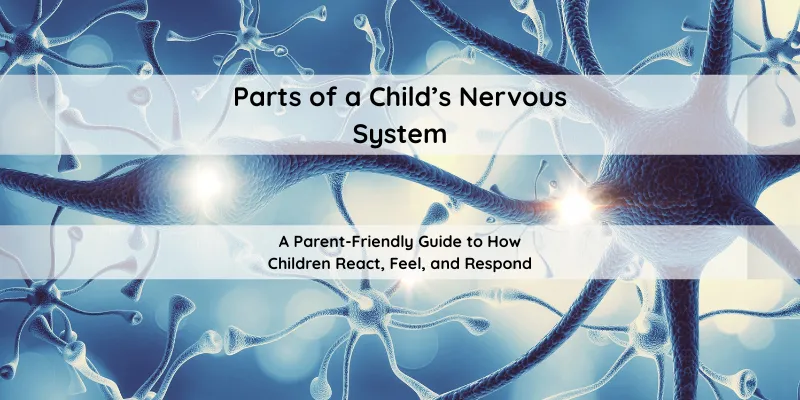
The nervous system is the body’s communication network.
It allows the brain and body to exchange information about what is happening both outside and inside us.
If your child touches something hot, hears a sudden noise, feels hungry or notices another child moving towards their toy, sensory information travels through the nervous system and contributes to the brain’s response.
The nervous system is commonly divided into two broad parts:
- the central nervous system, which includes the brain and spinal cord, and
- the peripheral nervous system, which includes nerves connecting the central nervous system with the rest of the body.
Together, these systems allow children to sense, move, think, feel and respond.
What does the central nervous system do?
The central nervous system, or CNS, consists of the brain and spinal cord.
The brain receives and integrates enormous amounts of information. It contributes to everything from movement and language to memory, emotion, attention and decision-making.
The spinal cord carries information between the brain and much of the body and also contributes to rapid reflex responses.
Rather than acting like one simple command centre, the brain contains many interconnected networks that work together.
A child’s emotions, behaviour and self-control do not come from one isolated “part of the brain”; they emerge from several systems communicating with each other.
What does the peripheral nervous system do?
The peripheral nervous system, or PNS, includes the nerves outside the brain and spinal cord.
These nerves carry sensory information towards the central nervous system and carry signals from the central nervous system back to muscles, organs and other parts of the body.
This helps explain why physical experiences can have such a strong effect on behaviour.
A child might become distressed by:
- a scratchy clothing label,
- a loud hand dryer,
- a crowded room,
- bright lighting,
- an unexpected touch,
- or feeling hot and uncomfortable.
Another child might actively seek movement, squeezing, jumping or rough physical play because these sensations feel enjoyable or regulating.
Behaviour is often influenced by the way a child’s nervous system receives and responds to sensory information.
What does the prefrontal cortex have to do with behaviour?
The prefrontal cortex is part of the frontal lobes and contributes to many of the skills parents rely on when they ask children to control their behaviour.
These skills include:
- holding information in mind
- planning
- inhibiting impulses
- shifting attention
- weighing consequences
- organising behaviour
- regulating emotions.
Together, many of these abilities are described as executive functions.
Children are not born with mature executive-function skills. They develop gradually through childhood, adolescence and beyond. Harvard’s Center on the Developing Child describes executive function and self-regulation as skills that help us manage information, make decisions and plan ahead, with their underlying brain circuitry developing over an extended period.
This matters enormously for parenting.
Your three-year-old might know that hitting is not allowed but still hit when frustrated.
Your five-year-old might understand the morning routine but forget the next step.
Your seven-year-old might know they should wait before interrupting but speak before they have managed to stop the impulse.
Knowing a rule and being able to apply it consistently under pressure are different developmental abilities.
Does a child’s “thinking brain” really switch off during a meltdown?
Not literally.
Parents often hear that the “thinking brain goes offline” when children become overwhelmed. It can be a useful metaphor, but the underlying neuroscience is more complicated.
During intense stress or emotion, the systems involved in threat detection and rapid response can become highly active, while executive functions such as planning, flexible thinking and impulse control can become less efficient.
Research on stress and executive functioning shows that acute stress can temporarily reduce the efficiency of prefrontal processes.
This is why a child in the middle of a major meltdown might struggle to answer questions, consider consequences or follow a lengthy explanation.
They have not lost their entire cortex.
But the skills needed for calm reasoning are harder to access while the child is highly emotionally and physiologically aroused.
What role does the amygdala play in children’s emotions?
The amygdala is involved in detecting emotionally important information, including potential threats.
It works as part of a larger network involving the cortex, hippocampus, brainstem and other structures.
The amygdala can respond quickly when something appears frightening or significant.
For a young child, the trigger might be obvious:
- a barking dog,
- a stranger,
- a sudden fall.
- At other times, what activates distress seems minor to an adult:
- the wrong cup,
- being asked to stop playing,
- a change of plan,
- a sibling touching their belongings.
The important thing to remember is that the child’s reaction depends not just on the event itself but on their developmental level, previous experiences, fatigue, sensory load and emotional state.
Children can react strongly to situations adults consider small because their regulation systems are still developing.
What does the brainstem do?
The brainstem helps regulate many automatic functions essential for survival, including breathing, heart rate, sleep-wake processes and basic arousal.
It does not independently “take control” during every meltdown, as simplified brain models sometimes suggest.
Instead, brainstem systems work continuously with other areas of the nervous system to regulate alertness and bodily state.
This is one reason physical conditions can have such a strong effect on behaviour.
A child who is:
- hungry,
- exhausted,
- in pain,
- overheated,
- ill,
- or heavily overstimulated
might have much less capacity available for patience and self-control.
Sometimes improving behaviour begins not with a behavioural strategy but with noticing what is happening in the child’s body.
What is the autonomic nervous system?
The autonomic nervous system helps regulate processes that mostly occur without conscious effort, including heart rate, digestion and aspects of breathing.
Two of its major branches are the sympathetic and parasympathetic nervous systems.
These are often described simply as “alarm” and “calm” systems.
That is useful for understanding the broad idea, although both systems are more complex and remain active in different combinations throughout everyday life.
What happens when the sympathetic nervous system becomes active?
The sympathetic nervous system helps prepare the body for action.
If the brain detects possible danger or intense challenge, sympathetic activity can contribute to:
- faster heart rate,
- rapid breathing,
- increased alertness,
- muscle tension,
- and mobilisation of energy.
- In a child, this might accompany behaviours such as:
- running away,
- crying,
- shouting,
- hitting,
- freezing,
- or becoming extremely restless.
This is often described as the fight-or-flight response, although children’s responses can be more varied.
A highly activated child might appear deliberately difficult when their body is actually preparing to respond to perceived stress or threat.
This does not mean the behaviour should be allowed to become unsafe. It means parents will usually have more success reducing arousal before attempting a lengthy discussion.
What does the parasympathetic nervous system do?
The parasympathetic nervous system contributes to processes involved in resting, digestion and recovery.
After a stressful event, parasympathetic activity can help the body return towards a more settled state.
Activities that some children find regulating include:
- slower breathing
- predictable routines
- gentle rhythmic movement
- quiet play
- cuddling when the child enjoys physical contact
- sitting with a calm caregiver
- slow counting
- reducing overwhelming sensory input.
These strategies do not simply “turn on” one nervous-system switch.
Instead, they can help create conditions in which physiological arousal gradually decreases.
Calming is a process, not a button.
How do a child’s senses affect behaviour?
The nervous system continually receives sensory information.
Most people are familiar with:
- sight
- hearing
- smell
- taste
- touch.
But child-development and occupational-therapy discussions also commonly include sensory information about movement, body position and internal bodily states. Sensory processing difficulties can involve both external senses and internal sensations such as movement and body cues.
Three useful concepts for parents are vestibular processing, proprioception and interoception.
What is the vestibular system?
The vestibular system contributes to balance, movement and our sense of where the head and body are in relation to gravity.
Children stimulate this system when they:
- spin,
- swing,
- climb,
- jump,
- roll,
- or hang upside down.
Some children actively seek large amounts of movement.
Others become uncomfortable or frightened by spinning, unstable surfaces or sudden changes in position.
This is one reason two children can have completely different reactions to the same playground equipment.
What is proprioception?
Proprioception provides information about the position and movement of muscles and joints.
It helps a child know where their body is without constantly looking at it.
Activities involving pushing, pulling, climbing, carrying and resistance provide strong proprioceptive input.
Some children enjoy this kind of input and might seek:
- rough-and-tumble play,
- jumping,
- crashing into cushions,
- tight hugs,
- or carrying heavy objects.
These behaviours are not automatically evidence of a sensory problem.
They might simply reflect the kinds of physical input that particular children enjoy.
What is interoception?
Interoception refers to the perception of signals arising from inside the body.
These include sensations associated with:
- hunger,
- thirst,
- temperature,
- heartbeat,
- breathing,
- pain,
- fullness,
- and needing the toilet.
Children gradually learn to interpret these signals.
A young child might become suddenly irritable because they are hungry without recognising the feeling as hunger.
Another might become extremely distressed before realising they need the toilet.
Some children have greater difficulty recognising or interpreting internal body signals. Raising Children Network notes, for example, that differences in recognising fullness and other body cues can affect some autistic children.
Helping children notice body signals can support emotional regulation because physical needs and emotional states are closely connected.
What is sensory overload?
Sensory overload can occur when the amount or intensity of sensory information becomes difficult for a child to manage.
Imagine a busy shopping centre containing:
- bright lights,
- music,
- people talking,
- shopping trolleys,
- strong smells,
- movement,
- announcements,
- and uncomfortable clothing.
An adult might automatically filter much of this information.
A child who is more sensitive to sensory input might experience the environment very differently.
They might become irritable, cover their ears, cling, run away or eventually melt down.
Sensory processing difficulties can involve becoming overwhelmed by sensory input or seeking particular forms of sensory experience.
When behaviour repeatedly changes in certain environments, it can be useful to ask what the child is seeing, hearing, touching and feeling rather than focusing only on the behaviour itself.
What does it mean when a child is “regulated”?
Regulation means that the child’s level of emotional and physiological arousal is manageable enough for the situation.
A regulated child is not necessarily quiet.
A child can be excited, energetic and loud while still being regulated.
They can generally respond to other people, adjust their behaviour and recover when something changes.
A dysregulated child has more difficulty controlling reactions because their arousal has moved beyond what they can comfortably manage.
This might look like:
- crying,
- aggression,
- frantic movement,
- withdrawal,
- freezing,
- or becoming unable to follow familiar instructions.
Regulation is not the same as obedience or stillness. It is the ability to manage internal states well enough to respond flexibly to what is happening.
What is co-regulation?
Young children do not learn emotional regulation entirely by themselves.
They first experience regulation through relationships with adults.
A caregiver might:
- hold a frightened toddler,
- speak slowly,
- reduce stimulation,
- help name an emotion,
- provide a predictable routine,
- or remain nearby while the child settles.
Over repeated experiences, children gradually develop more of their own regulatory capacity.
This process is often described as co-regulation.
Executive-function and self-regulation skills develop over time through experience and supportive relationships rather than appearing fully formed in early childhood.
Before children can reliably regulate themselves, they frequently need adults to help organise the emotional environment around them.
Why do children lose control more easily when they are tired or hungry?
Self-control requires resources.
A child who has slept well, eaten recently and spent the morning in a manageable environment has more capacity available than the same child after a long, noisy day.
- Fatigue can reduce attention and impulse control.
- Hunger can create physical discomfort and irritability.
- Sensory overload increases demands on regulation.
This is why a seemingly tiny event can trigger a huge response at the end of the day.
The wrong cup might not really be about the cup.
A child’s final trigger can be small because their nervous system has already been managing many demands before that moment.
Does every meltdown mean the nervous system is overloaded?
No.
Meltdowns and tantrums can arise for many reasons.
A child might be:
- frustrated,
- testing a boundary,
- avoiding a demand,
- overwhelmed,
- tired,
- anxious,
- disappointed,
- or struggling to communicate.
Several of these can occur at once.
Nervous-system language is useful when it helps adults understand regulation, but it should not become a catch-all explanation for every behaviour.
Understanding the nervous system adds context to behaviour; it does not replace careful attention to learning, relationships, boundaries and individual circumstances.
How can parents support a child’s nervous system?
Parents do not need specialist equipment or complicated “nervous-system regulation” programs.
- Start with ordinary developmental supports.
- Maintain reasonably predictable routines.
- Protect sleep.
- Provide regular food and opportunities for movement.
- Prepare children for transitions.
- Reduce unnecessary sensory load when they are already overwhelmed.
- Use simple instructions during distress.
- Offer closeness when the child wants it.
- Teach emotional language.
- Practise calming skills when everyone is already calm.
- And maintain clear, safe boundaries.
Supporting regulation usually involves making demands manageable while gradually helping children develop the skills to handle more for themselves.
Should parents use sensory tools to calm children?
Sometimes.
Movement, fidget objects, headphones, quiet spaces or particular forms of touch can help individual children.
But there is no single sensory tool that regulates every nervous system.
Deep pressure can feel calming to one child and unpleasant to another.
Spinning can organise one child and overstimulate another.
The child’s preferences and responses matter.
If sensory difficulties are persistent and interfere substantially with dressing, eating, school, sleep or everyday participation, parents can discuss them with a GP, paediatrician or occupational therapist.
Why should calming strategies be practised when children are calm?
A child who is already extremely overwhelmed has limited capacity for learning a completely new skill.
It is much easier to practise:
- slow breathing,
- counting,
- asking for a break,
- naming emotions,
- or using a visual routine
- when the child is settled.
Then, when distress begins to rise, the strategy is already familiar.
This is similar to practising a fire drill before there is a fire.
Regulation skills are learned during ordinary moments and gradually become more available during difficult ones.
What should parents remember about the nervous system and behaviour?
Perhaps the most useful idea is that behaviour does not happen separately from the body.
Children’s ability to listen, cooperate, manage disappointment and control impulses changes according to development, stress, sensory input, sleep, hunger and emotional state.
That does not make children powerless over their behaviour.
It explains why self-control needs to be taught gradually and why some moments require more adult support than others.
Understanding the child’s nervous system allows parents to combine empathy with boundaries: first helping the child become capable of regulating, then helping them learn what to do differently next time.
Where can I learn more about children’s emotions and regulation?
For more practical articles about emotional regulation, tantrums, sensory experiences and child development, explore the Child Care Guide Blog.
You can also read Why Counting to Ten Can Help a Child Calm Down for a closer look at how simple grounding and attention strategies can support an overwhelmed child.
If emotional or behavioural difficulties are persistent or significantly affecting everyday life, our Child Mental Health guide explains common conditions and when professional assessment might be helpful.
Reviewed and updated: 12 August 2026